When I was in college, I enlisted in a Fiction 101 class. I was terrible at fiction – I’ve only marginally improved since – but I had a nationally known storyteller as my professor. This man fit the artist stereotype perfectly: eccentric, philosophical and brilliant. I was terrified at the thought of him evaluating my n00b story writing skills but I also considered it a real honor.
One thing I remember him telling us is this: “Inspiration is a lie. If you keep waiting for inspiration to hit you, you’ll be waiting forever. So what do you do? You kick yourself in the butt and you get to work.” He had said this at a point when I found myself constantly surrendering to the hand of Writer’s Block. Every time I got stuck, I’d tell myself that I just had to wait the damn thing out until I found the momentum to try again. But what he told me that day was that this strategy was a farce. It was the game plan of the lazy.
In the years since then, I’ve had to redefine and rediscover my own writing principles especially in the area of the phenomenon known as Writer’s Block. What I believe now is that it is a real and natural part of the process. Everybody, at some point in time, hits a wall. But we can’t use that as an excuse to stop trying. The wall is a challenge. We either climb over or break through it.
Or we stay stuck forever.
I asked a few of prolific writer friends of mine about their own thoughts on Writer’s Block and what they do to try to overcome it. Check out their answers:
Carina Santos
Artist & Blogger, www.nothingspaces.com
I don’t think writer’s block is a myth—there are just those days when you can’t seem to write a coherent sentence that you don’t want to cringe at. However, I do think that it’s easy to use it as a “copout excuse.” If I find myself wanting to write but seemingly unable to, I move on to some other thing I should be or have been thinking about writing. I think there are days when what you write doesn’t feel right or true, but fixating on that is a really easy way to get stuck. I like just writing what I can, and leaving a space for things I can’t seem to write about to fill in for later. This is what the editing step is for, anyway. When something doesn’t sound right, I just get back to it with clearer eyes after a break from the struggle with it.
Eliza Victoria
Novelist, www.elizavictoria.com
Charlie Jane Anders wrote a pretty good article over at io9 called “The 10 Types of Writers’ Block and How to Overcome Them“. I’ve always defined writer’s block as that period when you can’t write anything, but as Charlie illustrates, you can have writer’s block even while working on something. And how do you define “writing” in this context anyway? “Writing” as in the actual act, the sitting down to type and string words together?
In writing (and any other creative endeavor), the work that requires the most energy and brainpower is not the act of writing itself, but the planning phase. An idea often comes unbidden, and before you can execute this idea and turn it into a story, a poem, a painting, a song, you need hours and hours and HOURS of thinking.
Creators don’t mind spending so much time on an idea, because it doesn’t feel like work. It’s daydreaming, it’s play. It happens while you stare off into space in the middle of an office meeting, or smile vacantly at a relative during a family reunion. (I know you’ve done this at least once or twice.) As long as you keep doing that — as long as you daydream, as long as you tell yourself stories, say, about the annoying person standing beside you inside the MRT — I think it’s impossible to be stuck.
We “write” every day because we tell ourselves stories every day. Sometimes I worry when I don’t have any ideas for a new story. And I realized: the problem is the worrying. I should stop worrying and just watch a film, read a book, read a poetry collection, eavesdrop on people’s conversations inside a restaurant (What? You’ve done it.) and the idea will come.
Kyra Ballesteros
Professor, University of the Philippines
Writer’s Block exists, but it’s not an affliction. I tend to think of “being blocked” as taking a wrong turn. For creative professionals who must come up with solutions or new ideas or new perspectives, it’s only a matter of time until we write (or paint or draw) ourselves into a corner. But what’s important isn’t where you are NOW. What’s important is to keep moving.
And how do you deal with it?
1) Step away. I mean, stop thinking. Sometimes the best thing to do is to give up and start something new. Shelve the project for now. The trick is to come back, later, even when you return to the same dead end.
2) Stay where you are. Here is a hammer. Sometimes, what works best for me is to stay put and, despite better judgment, refuse to take a break.
I think the trick is knowing when to step back and when to plant your feet and refuse to budge. That kind of wisdom comes only after trying AND FAILING.
Bing Pizarro
columnist, Manila Bulletin
I think we all occasionally run into these road bumps and have bad days when we can’t seem to write or start writing. Staring at a blank page and not quite knowing how to begin is one of the daily struggles of people who write as a vocation or those who write for a living.
As I’ve gotten older though I’ve become less inclined to give it a name, because calling it writers’ block imbues it with a mythical power, as if we were at its mercy. Writing is difficult and there will always be bad days–just like there will be days when we don’t feel like reading or showering (admit it!), or days when we feel very lonely despite the flurry of activities we may be engaged in.
Over time though I’m learning that it’s less about the state of affairs we are in and more about developing the discipline to pick ourselves up and keep on, the stubborn determination to work at it, because writing is work.
What usually helps me is taking myself out, out of my head and into the world: I sit outside and eavesdrop on people’s conversations on the street, I attempt to cook a new recipe, I watch a good movie to remind myself what good writing looks and sounds like. These external stimuli usually help, listening to voices other than my own. Then I get back to the blank page and wrestle with it and don’t let it go until I win.
I don’t think there’s a secret or a ritual to it. I think a large part of the discipline of writing lies in proving that our determination to commit words to a page is greater than the distractions or discouragements that plague us daily.
What’s your personal take on getting over the wall? Blog about it and post your link in the comments section below or shoot us an e-mail. We’d love to hear from you!
And whether Writer’s Block has found you as of late or not, our great hope as your personal Galvanizers is that you don’t quit on yourself or your dream. I’ll end this with a quote from the amazing Cheryl Strayed: “I know it’s hard to write, darling. But it’s harder not to. The only way you’ll find out if you “have it in you” is to get to work and see if you do.”
Bottom line: keep writing.
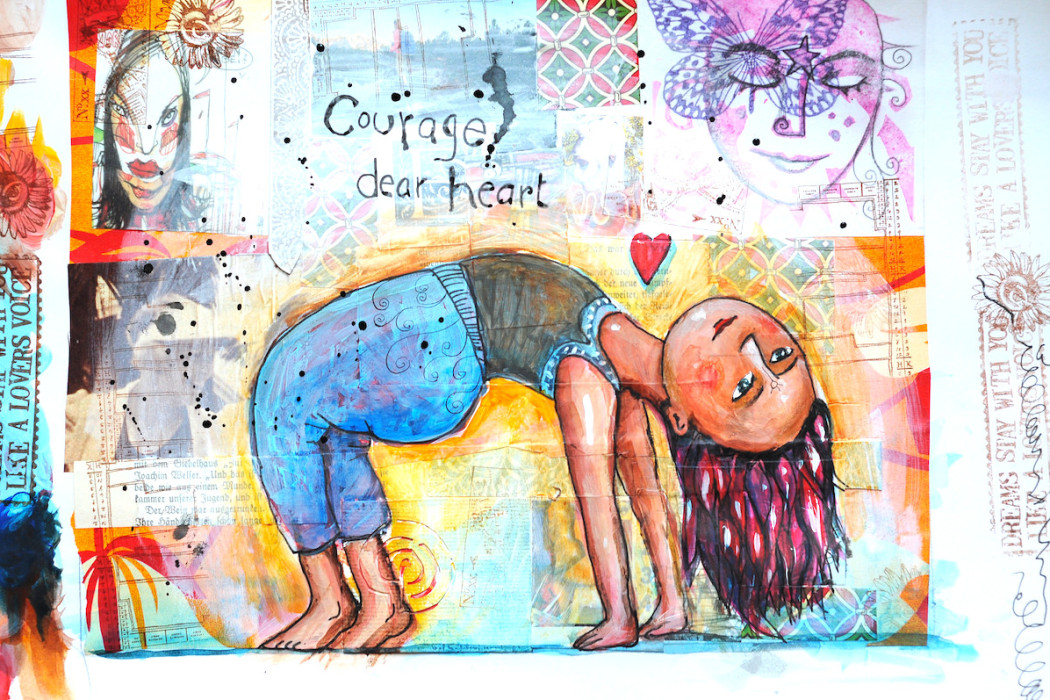
Image Attribution: “courage dear heart” by distelfliege is licensed under CC BY 2.0. The image has been brightened.