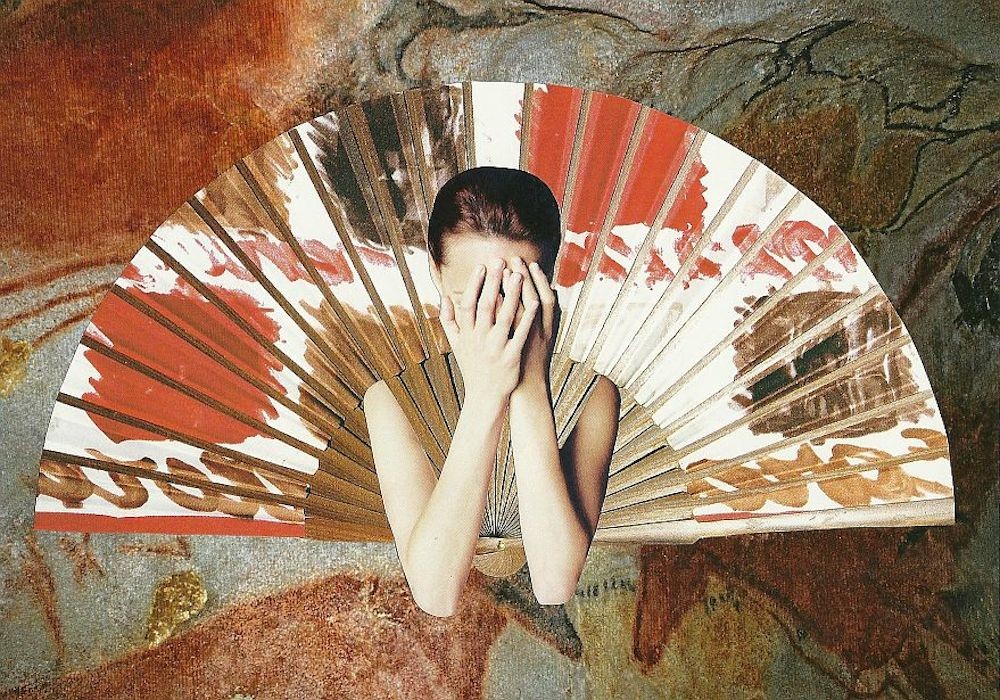
Around this time last year, I got into a funk.
A funk is different from writer’s block. Writer’s block is the general diagnosis we give for a stoppered imagination—a momentary bottleneck in the creative process. Deep down, you know what to say but you don’t know yet how to say it. The trail you’ve followed so merrily thus far may have gone cold, but it’s still there. Your biggest challenge is bridging the gap between where you have found yourself and where the rest of the trail might be.
Maybe you have to extend the trail yourself, stone by stone, or cut through the thicket in front of you, or follow the river downstream, all in the hopes that you will find yourself where the words flow more freely.
But when you’re in a funk, the trail vanishes. You’ve wandered off the path entirely and ended up deep in an unexplored part of the woods, where the leaves grow so thickly they block out the sun and you can’t tell which way is up.
In a funk, the air is weighted. It falls over you like a shroud. You lose your connection not only to the story you’re meant to write, but to your grip on what matters to you. All the reasons that give each of your actions a purpose—I write this because that, I do that because I want this—start to dissolve.
You look down and your toes are submerged in quicksand.
You’re stuck.
How the Writing Funk Came to Be
It was somewhat fitting, though a case of really bad timing, that I had gotten very deeply stuck just as we were supposed to publish an issue about getting unstuck. Then again, you don’t plan to get into a funk. They come unbidden.
If you’re lucky you might sense it coming, the way you detect the faint pulse of a migraine or the metallic tang of air that heralds an oncoming typhoon.
If you’re not, they come with a crash: one moment you’re laughing at a joke in a room filled with friends, and the next the trapdoor opens beneath your feet. You look up only to find that you’ve been unplugged from the world, and from the place where you find your stories. Your ability to write, to stay focused, to make decisions or even care about the decisions you make is gone.
I can’t remember the exact trigger that brought on the funk, but it was around the time I was preparing to leave for graduate school in London. Every rational bone in my body said this was a good thing. As a creative writing student, I was going to learn how to write better. I was going to have time to work on stories I wanted to write. And, come on. London?! I was a lucky, lucky girl.
Instead I felt indifferent. I still loved Manila. I had made good friends. I loved my family, and though we’ve spent long years apart it felt more difficult this time around. I was convinced that I was leaving before I was ready, in order to follow my heart, and as a result I considered my choice a compromise.
Because of it, I became resentful. Then guilty. Then I didn’t really feel anything at all.
For weeks, I slept through the day and lay awake at night. I spaced out. Some days I felt exhausted after having done nothing at all. I felt numb and lethargic, as human as a sack of rice, until the numbness was no longer a metaphor and manifested itself physically. A persistent tingling grew in my limbs. I had a panic attack in a restaurant. The hospital sent electric shocks through my limbs and drew blood, but found nothing the matter. They prescribed B-vitamin supplements, just in case.
When one is in a funk, time is elastic: the hours blend into a single second, stretching and unending. The real world slips away and in its place settles a void.
The Danger of “The Void”
The void is different from darkness. Darkness is as necessary as light: anger and sadness and evil and pain have their place in the world. But the void is dangerous: it’s a silent, airless universe in which your soul remains stagnant. You are paralyzed by indecision. It’s impossible to concentrate. Your perspective of the world shrinks until it’s no bigger than the eye of a needle: how can you consider the bigger picture when you can’t even see it?
Some of the symptoms and feelings I’ve described have been used for other issues of varying severity: anxiety, depression, and what some call “the blues.” I have never spoken to anyone or been diagnosed, nor am I attempting to equate what I felt to something more serious.
But the void calls to us with the same siren songs. Some of us are more sensitive to it than others. Some live with a foot in the void at all times. Some of us can detect its presence, with the same peripheral awareness we use to gauge the safety of our immediate space, and keep it well at bay. Others still are blissfully immune.
People who are creative tend to be especially aware of the void. It is a great fear to lose one’s sense of purpose; to feel like we have nothing important to say, or no way to say it. To think: if we did find a way to say or do things, how long before we stumble upon someone who found a better way?
We mistakenly convince ourselves that our fears are lesser fears, because they are not fears of the hungry or homeless. We find fault with ourselves as readily as water flows downstream.
We shouldn’t.
The greatest danger of the funk is that it purports the illusion that we are alone. It’s hard to see, when we’re caught in a pinhole-sized view of the world, that those right next to us harbor their own dreams and fears. It’s hard to trace the links our actions forge to other people and greater events, but they are there.
We do have purpose. We do have something to say, and our words and art and music do matter. The dreams we’re scared to say aloud, the dreams we thought long dead and buried, the dreams that keep us awake and whisper at the doorstep of our consciousness—these are the dreams we need to fight for.
This is how a funk gets broken: when we take up a sword and fight our way through the void.
It’s hard for me to not think of Robin Williams, who killed himself last August, when I think of how the void can take the best of us. I couldn’t get a certain image out of my head, of a man filled with light dispersing into millions of bright petals, each one drifting through the darkness and settling into the cupped hands of someone he made laugh.
We all have a duty to stand up against it, whatever it may be named.
Whether it is for ourselves or for others.
How to End a Writing Funk
1. Be kind to yourself.
Why is it that we will cut breaks for others that we would never give to ourselves?
One of the siren songs of the void that I’ve learned to recognize is the one that tells me to compare myself to others. To succumb to envy. To punish myself for not being younger and more successful, with goals as straight as the runway lights.
After a barrage of those thoughts, I threw up my hands and said, “I don’t care.” Which taught me to say, “It’s OK.” It’s OK to be myself, to put my needs before others, to be selfish in that way. To not let the achievements of others be the ruler by which I measure myself.
It is OK to be selfish as long as you’re not hurting anyone else. When other people succeed? Acknowledge their accomplishments and congratulate them if you’re genuinely happy, but if you’re not? Pay them no mind. Choose silence over insincerity. Don’t join in the chorus at the expense of your hurt soul.
2. Take all the time you need
When I was in a funk, I’d spend days watching Youtube videos. I marathoned Korean dramas. I drowned myself in Internet k-holes, swimming through its dregs until five minutes in and you’ll never guess what happened next!
There will be throwaway days. 60% of TED talks are designed to remind you that every day is a precious gem and if we waste it we might as well throw ourselves in a ditch as failures. They are meant to be inspiring, and most times they are. But sometimes they can make us feel even worse.
The fight against the funk can be a long one, and some days will be lost to the battle. This is OK. It is more harmful to place unrealistic expectations on your progress, or to define a arbitrary deadline you have no way of meeting. There is no shame in going slowly.
I repeat: it is OK to go at your own pace, and to surrender some days to the funk.
3. Remove influences that make you feel shitty
I went through a small social media purge and unfollowed people/accounts that made me feel shitty. There wasn’t really a process to it: I kind of just decided to stop caring (it’s a longer story than that, but for another time) about things that distracted me, or that reminded me of my deficits rather than my strengths.
Maybe for you, a shitty influence is someone who Instagrams motivational posts nonstop. Or someone who is always complaining about their life. Maybe a shitty influence brags about things they have and things they want. Maybe they ask something of you with every update: a compliment, your admiration. It’s different for everyone.
I learned to appreciate people who didn’t try to seem so happy all the time. People who posted pictures of works in progress, rough drafts of their work, messy desks and planners filled with hopeful predictions for the day. People who talked about their writing equipment, the books they were reading. People who went on long walks and traveled sincerely and spent time with their family. Over several months, they reminded me of where my focus ought to be.
4. Journal your heart out
The only thing you really need to journal is a willingness to be honest with yourself, and to trust yourself to put your thoughts to paper/blog post. No one has to know you keep a journal. It can be as private or as public as you want it to be.
Keeping a journal helped me process my feelings in a way that I could never verbalize otherwise. I started doing it seriously in July 2014—remember what I said about wasted days? There are whole sections of my journal that are just extended pity parties. If they survive long enough to be uncovered by descendants, they’d think Crazy Great Aunt Bea was a raging asshole.
But that was the purpose my journal served when I was in a funk. It was the sea into which I emptied my frustrations so my head and heart could be free.
These days my journal entries are blessedly brief, but whenever I find myself slipping back, I return to the pages and know they will help me get through the funk. Plus, journaling is great for working out any writing problems.
There are resources abound on keeping a journal, but the National Journal Writing Month site is a good place to start!
5. Revisit your favorite worlds, or immerse yourself in new ones.
When my own words wouldn’t come, I buried myself in familiar ones. I reread books from my childhood that made me fall in love with writing: Catherine Called Birdy, The Witch of Blackbird Pond, A Swiftly Tilting Planet, Crown Duel/Court Duel, The Abhorsen Trilogy. I could go on, but you get the point!
I remembered what it was like to feel almost breathless when reading, to return to favored sections again and again. To excavate another pebble of meaning from the story with every pass.
With promises of romance and epic adventure and injustices made right, each book pulled me further away from the funk. And brought me closer to my own words and stories, in the hopes that one day I’d be able to do the same.
6. Get some perspective.
I hate it when people try to “fix” your problems by comparing them to bigger ones. I’ve been guilty of doing it, too. The greater ills of the world do not invalidate your own struggles—if that were the case, no one should be allowed to be upset. Conversely, does that mean no one should be allowed to be happy, if someone else has a greater reason to be happy?
But. When your problems appear to consume your entire world and it is within your means to do something about it, you probably should. In some cases (not necessarily all), funks can become worse because we give them the time and focus and energy to grow. We look at them as though through a telescope, with the rest of the world concealed.
Find something, even if it’s not writing related, that requires your time and focus and energy. Some people find that adapting a routine helps—taking up exercise, or a class, or a social cause. Some set daily or weekly goals: to drink a certain amount of water, take a certain amount of steps. Whenever I can sense the blues coming, I turn to cooking. I go for walks. I remember that I am lucky and I am loved.
Sometimes inspiration strikes this way. Sometimes it doesn’t.
I commend those who can recognize inequalities in the world and find purpose in righting them. But sometimes the answer is looking after yourself, not other people. It is not so bad a thing.
7. Find a change of scenery.
I know that this is not always a feasible method. We can’t all find the answers to our problems in Italy and India and Bali. But I have to mention it because in my case, it was relevant. A change in scenery pulled me out of my funk and made me a more positive and productive person.
As predicted by practically everyone, moving to London was the best thing that could have happened to me. I met smart, motivated, and supportive classmates, some of whom have become close friends. I experimented with a new writing style, and wrote stories I never imagined that I could write. I visited book fairs, met authors, interned at a publishing company, and saw that the industry was so. Much. Bigger than ever anticipated.
While this can be a daunting realization, it’s also rather motivating: there’s room for everyone. You just have to show up and be ready.
You don’t have to up and move to a different continent—I’ve seen friends find solace in nearby beaches, or in cozy cafes. If you’re a homebody, it might mean just spending the day out of the house.
8. Find your galvanizers.
The most important suggestion for last: find people you can talk to, and who can help you. Who remind you that you’re not alone. Who will sit there with you and listen.
There are few things as rare in the world as someone who will listen. Even rarer still is the person who will listen and then turn around and tell you all the things you need to hear. Not necessarily the things you want to hear: otherwise they’re just enabling you. But the things you need to hear, in the way you need to hear them.
Treasure these people, whether they be friends, family, or an online community. And remember that to cultivate a relationship with them is to trust them with your vulnerabilities. It might be scary at first, but just remember: they might understand you more than you realize.
We are all made of the same cosmic matter: we are all finding our way towards our purpose, and away from the void.
We are not alone.
A year on and I’m out of the worst of that funk, though there are still moments where I can feel it there, hovering on the periphery of my waking world. Whenever this happens, I try to remember all the points above and let it pass. I will write another story. I will read another book. I will find a new idea wedged in the corner of an unexplored street. I will take my time.
I’m in a good place. And if any of this feels familiar to you, I hope with all my heart that you will be too. I know you’ll be. It is our duty to help each other get there, together.
Image Attribution: “I still miss him so bad” by Joana Coccarelli is licensed under CC BY 2.0. The image has been enlarged from its optimal size.