Outlining is a glorious task. Well, it is for some writers. Nothing gets me going more than a stack of fresh index cards, ready to be transformed into scenes. Or a sheet of paper set to be split into a universe of various subplots. But while exciting, outlining is kind of intimidating, mainly because you’re trying to structure the thoughts adrift in your mind into something somewhat plausible. Your daydreams of perfect characters doing things perfectly have to actually represent a beginning, middle, and end.
Okay, so maybe outlining isn’t a completely glorious task. Truth be told, it’s rather scary. But it’s a hell of a lot less scary than diving straight into Page one.
What is an outline?
The outline is the storyboard of your written work – the master plan that lays out the 5 W’s of each scene: who, what, where, why, and how (never mind that it doesn’t start with a W). No storyboard is the same – they tend to be a reflection of how your mind works. Some writers outline every minutiae of their story, capturing each detail on an almost fractal level. Others scribble notes of their epics on 1 or two index cards, or whichever clean surface is closest. Others avoid storyboards completely, opting to channel the Muse directly without the added cost of a medium.
There’s no one way to go about outlining or storyboarding (terms I’ll use interchangeably here, even though in film and comics they mean different things). This is good; that means storyboarding is impossible to mess up. You might find that the initial method you’ve chosen is difficult to implement, or that you have to rewind and start over during the process. That’s not messing up. That’s revising. The storyboard, to some extend, is a dynamic, living thing. I say to some extent because if you constantly change the outline by entertaining every whim, it sort of defeats the purpose of having structure.
Why Storyboards/Outlines Are Glorious
Outlines make your project real
Ideas are born in Imaginationland, but stories come from Earth.Imagination land is perfect; Earth kind of sicks. People get trapped on Page One because no idea will ever be as good as it is in Imaginationland.
They’re not supposed to be. Storyboarding is the first step to bridging the gap between the perfect world where your stories are born to the reality of your own efforts and talents. Outlines force you to consider action and motive, to give all of the squee-worthy romance scenes the context they need. “But I just want my characters to kiss like they’re doing in my head!” you might say. That’s fine, but the rest of us need some background information to help us feel all the feels you feel. Even Stephenie Meyer had to give her sexy vampire dream some semblance of a plot.
Imaginationland is a lot of fun, but it’s not where stories belong. Think of your ideas as molten gold, and your outline as the mold into which it must be poured. What shape will it take once it comes to life?
Outlines give you a beginning, middle, and end
When I attended Mina’s #romanceclass workshop, my batchmate Krissy (and a Galvanizers contributor) didn’t even have an idea, much less a plot, at the beginning of class. Three hours later, she had a sypnosis and an ending. We were tasked to outline in more detail as homework, but having concrete anchors to the big moments in our stories were absolutely crucial for working out the smaller bits.
Having a proper beginning, middle, and end pulls your story from the primordial soup of perfect ideas into a very real, sometimes unattractive form. It forces you to think about the story in its entirety — everything must lead up to some kind of climax, and everything must be a sensible progression from the past.
Outlines give you scenes to anticipate
In a joint workshop with co-editor Isa, I talked about candy bar scenes – scenes that get you all a-tingle, the ones you’re dying to write. Outlines can help you identify such scenes, which can then be used as motivation to power through some of the more difficult scenes. Some of my candy bar scenes make it relatively intact from Imaginationland, but most were discovered during the storyboarding process.
Plotting out juicy scenes forces you to consider how and why certain scenes play out. Maybe to bridge the gap between two scenes, there exists an opportunity for something cute to happen. Or maybe when fleshing out an action scene you find the perfect place for your MC to debut a new skill, or just kick some serious ass.
We need the dangling carrots ahead of us to keep motivated. Except whoever found motivation in a bunch of dangling carrots? Horses don’t write stories (Black Beauty doesn’t count; he narrated his story to a horse whisperer). Find your carrots. Or smore-flavored ice cream. Whatever floats your boat.
Forewarned is fore-armed
In one of my favorite books growing up, From the Mixed Up Files of Mrs. Basil E. Frankweiler, head bitch in control Claudia Kincaid stops her brother from tearing into a madcap search and says, “Five minutes of planning is worth fifteen minutes of searching.” Often, people lose momentum because they lose sight of what happens next.
A detailed outline is a map that keeps you moving forward. You might find that you have to change gears, or that scenes need to be gutted or rewritten or replaced, but that’s what the revision stage is for. If you get tripped up because of a plot hole or inconsistent character behavior, you can just revise the affected scenes in the outline without getting derailed completely.
Not to mention that storyboarding in advance mitigates such things happening in the first place (though we are all beholden to the law that writing, as an endeavor, is more pain than pleasure. Totally didn’t mean for that to rhyme.)
Finetune stories through outlines
A complete storyboard allows you to see things tat are less easy to see in writing. One big example is pacing. Through a layout of scenes you can tell in a glance if the space between the introduction of the McGuffin and saving/destroying the world is kind of abrupt, or if the momentum fizzles between the start of the adventure and the actual adventuring.
One YA novel I started without an outline was taking forever to get to the main plot from an action-filled beginning. My problem: I didn’t know what the main plot was, exactly, and I didn’t realize how much the beginning dragged until I’d written another third of the story. I had to cull 8,000 words and shift some of the details I’d tried to cram in to later on in the story.
In addition to pacing, outlines can help you track your various subplots, that your character development is consistent, that the timeline is coherent, and that the continuity is sound. Do you need to have all this in your outline? No. Not at all. Just enough for you to work with. In fact, overthinking an outline can work against your favor.
When does an outline not help?
Spending too much time on an outline hurts more than it helps. The outline becomes a proxy of Imaginationland – that magical place where ideas remain pure and unsullied by one’s own hideous words. “Maybe I should tweak the middle a little more and refine the relationship between these secondary characters who meet once and never again.” No, no you should not.
The whole point of an outline is to get you to start writing. The moment it becomes an escape from writing, it’s no longer an effective tool. How do you know when you’ve reached this point?
1. You’re not writing.
2. The first point again.
Outlining finds the answers to questions you do not know. Once you have enough of those questions to start a scene, you’re ready to write.
I speak from experience here. So many outlines have turned into an extension of Imaginationland that I’ve forced myself to study my notes in sections only. I am Houdini when it comes to actually writing things down. I’d escape writing a grocery list if I could.
How do you find an outline that works for you? The best way is the long way, and that’s through trial and error. In the second part of this feature, I’ll share the outlining methods I currently employ or that I’ve tried to use in the past. Knowing how to outline really depends on: your preferences, the project you are writing, and your writing style.
Whether you use these methods or not, I hope they clarify the beauty of following an outline, and thinking about the who, what, and where of your words. As for the heart? That is revealed in the writing itself.
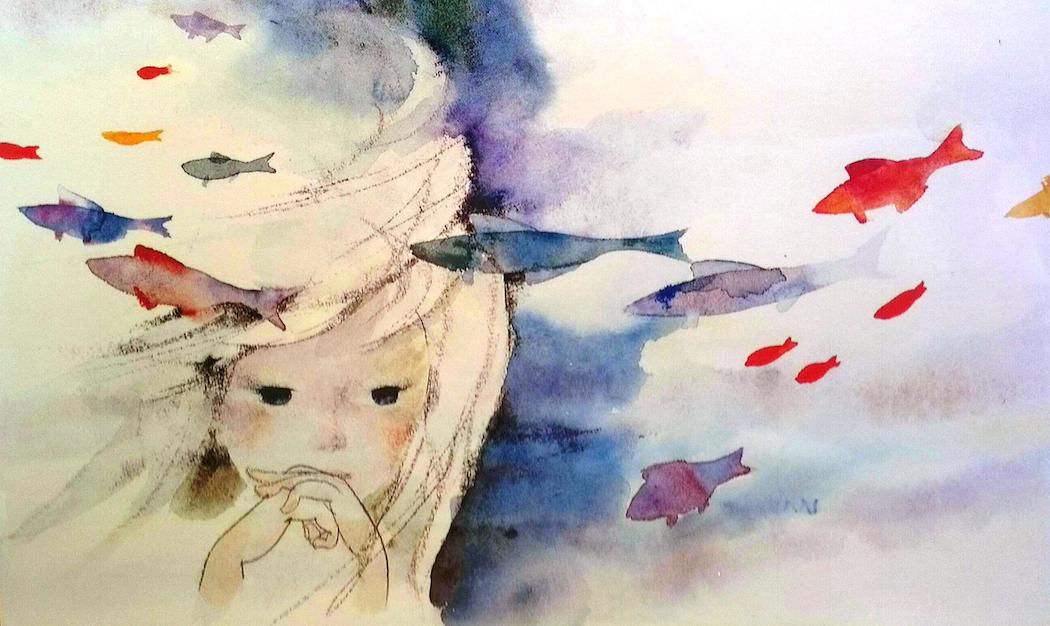
Artwork by illustrator Chihiro Iwasaki