Changing the Shape of Gender
The twenty-first century brings with it worldwide change. Contemporary society is like none before it; advances in technology allow human society, for the first time, to truly be different from any culture that came before, and with the help of that technology, to truly experience things for the first time. As technology has adapted to society so society has adapted to it, morphing the roles of humans in the modern world.
Gender roles have changed along with the rest of modern culture. In the twentieth century, the evolution of women’s rights gave women opportunity to be more than just wife and mother. The role of man as the “protector” of society has also been modified; women are allowed to serve in the armed forces, and technological advances on the war front have made hand-to-hand combat virtually extinct for soldiers; swords and bayonets have been replaced with by rifles and missiles.
As much as the world has grown and progressed, the stories we tell to each other remain much the same: stories of love, stories of war, stories of revenge—at their core is a structured division of human beings as either man or woman.
Would the plot of Frankenstein have worked the same if the titular character were a woman instead of a man? If the creature were created female? Perhaps—but with the gender binary comes a set of assumptions about our characters. If Victor Frankenstein had designed a female creation, we would assume there to be an (even more obvious) erotic subtext. If Victor had been a woman, we would assume even more than we do that “Victoria” was a projection of Mary Shelley’s own identity and complicated feelings about motherhood.
Beyond the Binary
The concepts of gender and sexuality are much more complicated than a binary. Humanity is more than “men and women” or “straight and gay.” If Victor Frankenstein identifies as agender or pansexual, or if the creature identifies as transgender or asexual, the protagonist’s motivation for creating new life becomes even more complicated, as does the creature’s motivation for revenge. It’s a new complication to the story of the mad scientist that now borders on cliche.
Although Dr. Alfred Kinsey first presented the idea of the sexuality/gender scale in the early twentieth century, it has since come to be regarded by the young internet-savvy generation as a spectrum, as varied and intricate as the colour spectrum. With a spectrum, the possibilities for our human identities are endless.
So why create a world without men or women?
Why not?
For my own writing, I choose to embrace complexity by creating a society and a story that eschews the gender binary. I began my first novel five years ago as a Young Adult story set in a high school. Think Mean Girls but without Tina Fey’s wit and with more angst.
After completing the first third of the book, I found that I didn’t identify with the setting or the characters I had created, so I rewrote the chapters in a scifi dystopia. This time, the setting resonated with me, but I still couldn’t decide whether or not the main character should be male or female.
Frustrated, I consulted a writer friend of mine, who has (metaphorically and okay, maybe literally once or twice) held my hand through every step of this writing process. “Why do you have to choose?” she said. “Why don’t you just create a character that is more than their gender? Genitalia shouldn’t define anyone.”
What began as genuine confusion over whether my protagonist should be man or woman turned into what later became the crux of my latest writing project: what would a world look like that didn’t follow the gender binary? Could a world exist that defined people as just people? What would a world look like that had no sexism and no homophobia? How would this change how I write?
Short answer: it’s complicated.
Embracing the Spectrum
The more I work on this project, the more I must change my own approach to gender. In creating non-gendered third person pronouns for the characters, I occasionally find myself slipping into the normative “he” or “she” because it’s familiar, and, dare I say it? It’s easier to remember because they’ve been ingrained in my worldview since birth. In attempting to avoid a gendered view of the characters’ appearance, I neglect my descriptions of them, and am constantly scribbling “MORE DETAIL’ in the margins of my manuscript.
In adopting a first-person perspective for my protagonist, I must adopt their way of thinking—and approaching a world without gender is, I’m discovering, not without its prejudices. Humanity is imperfect, and eradicating one source of prejudice will emphasize another. The challenge in creating a genderless society is to figure out from where the new tensions and conflicts will emerge. Is it social class? Is it race? Is it shoe size? Perhaps not that last one, but by envisioning an agender Frankenstein obsessed with a creation with the perfect shoe size, you’ll have a hilarious retelling of the novel.
It’s fascinating, if at times tedious, to build a society whose construct is so dissimilar from our own and yet maintain enough similarities so as not to completely alienate the reader (and myself). The benefits, however, vastly outweigh the challenges I face in writing it. Instead of a binary of two preset social moulds to pour my characters into, I can create my own moulds, pour the characters into a shape of my choosing. Our views of gender and sexuality have changed much in the last century, and the new challenge we face, as writers, is creating works that reflect these changes. By producing characters that are not defined or limited by their gender, then neither is my story or, in turn, myself as a writer.
About K.N. Thorsen
K.N. Thorsen is an eternal student, a compulsive wanderer, a fandom expert, a promoter of equality, and a hopeful novelist. If smoke signals or seances don’t work, they are reachable at knthorsenwriter@gmail.com and @knthorsenwriter on Twitter.
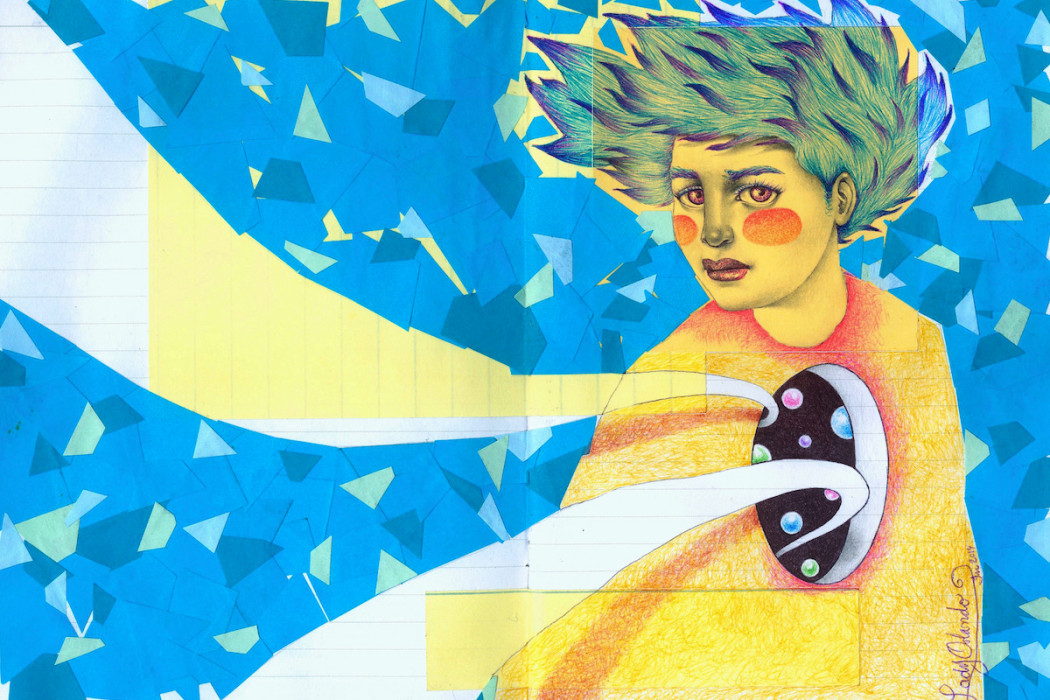
Image Attribution: “Floating” by Lady Orlando is licensed under Creative Commons (CC BY 2.0)